The Witch Head Nebula

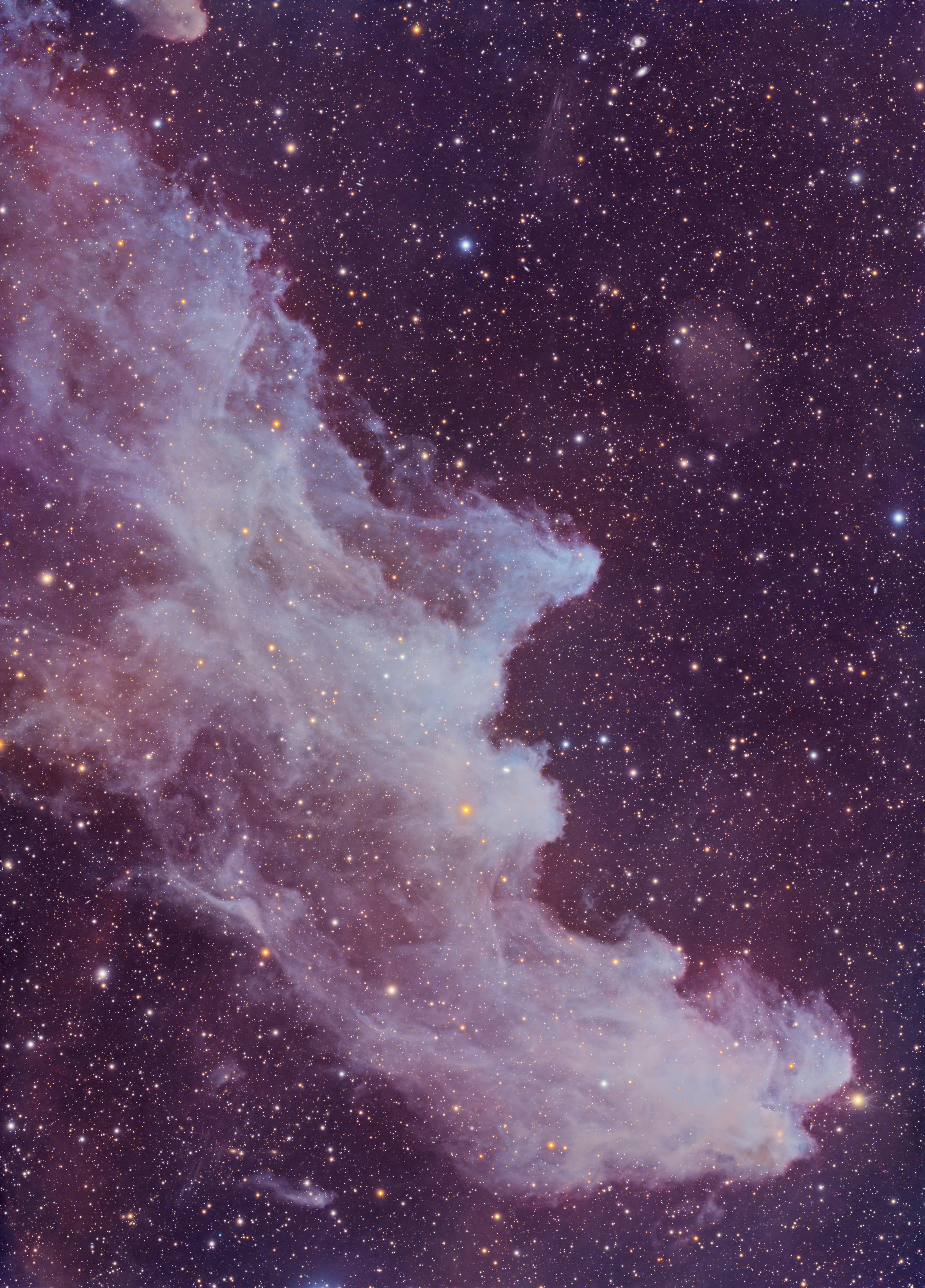

Lit up by the bright star Rigel in Orion, the “Witch Head Nebula” is a cloud of dust that reflect blue a little bit more. Unlike emission nebulas that emit their own light from ionized gases, this just reflects the light of Orion – although there *is* some ionized Hydrogen in the background, which you’ll find throughout this part of the sky.

First let’s have a look just in natural light:
If we add in some of that Hydrogen gas collected through a narrowband filter, some of that red ionized light becomes visible:
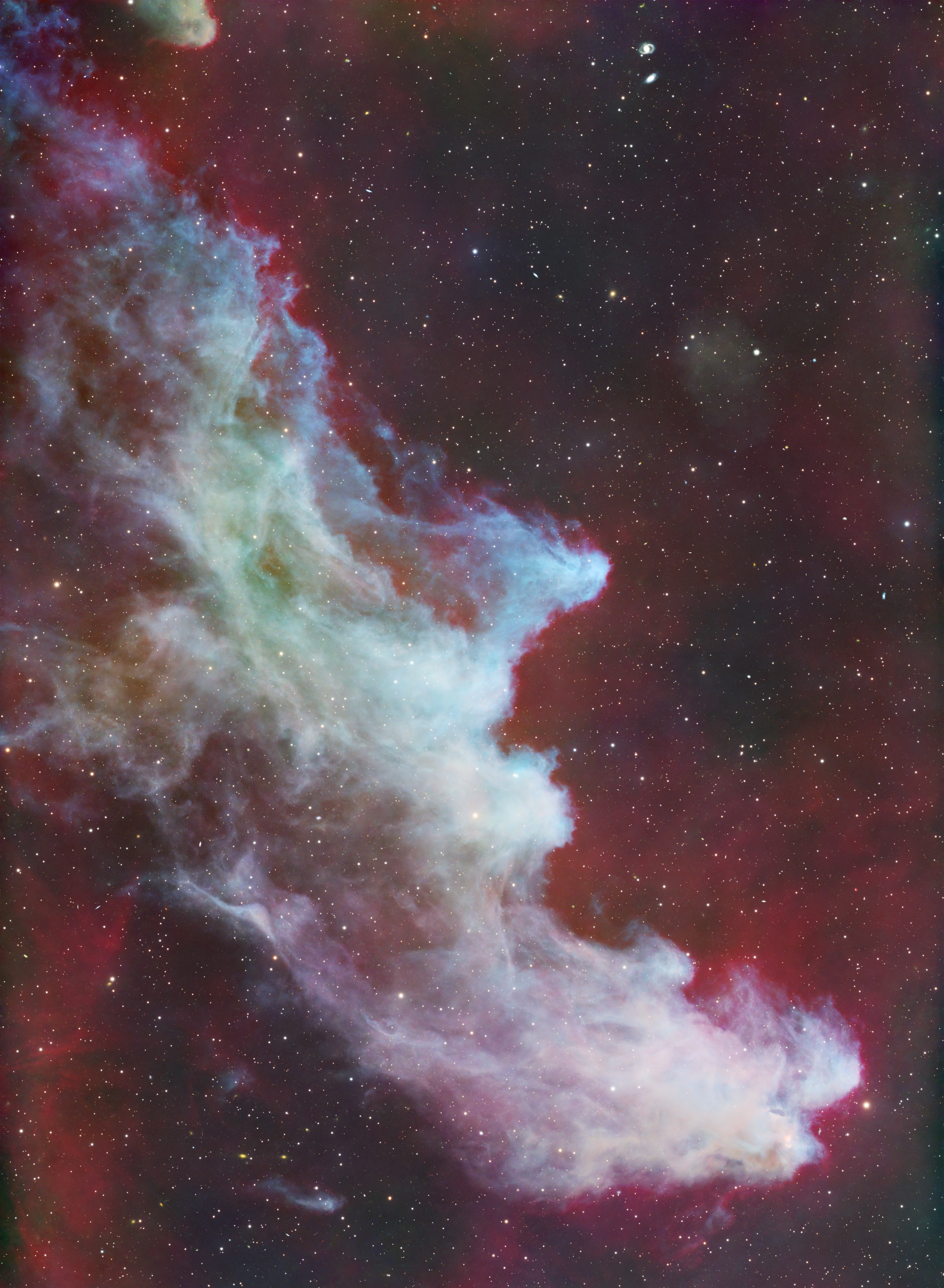
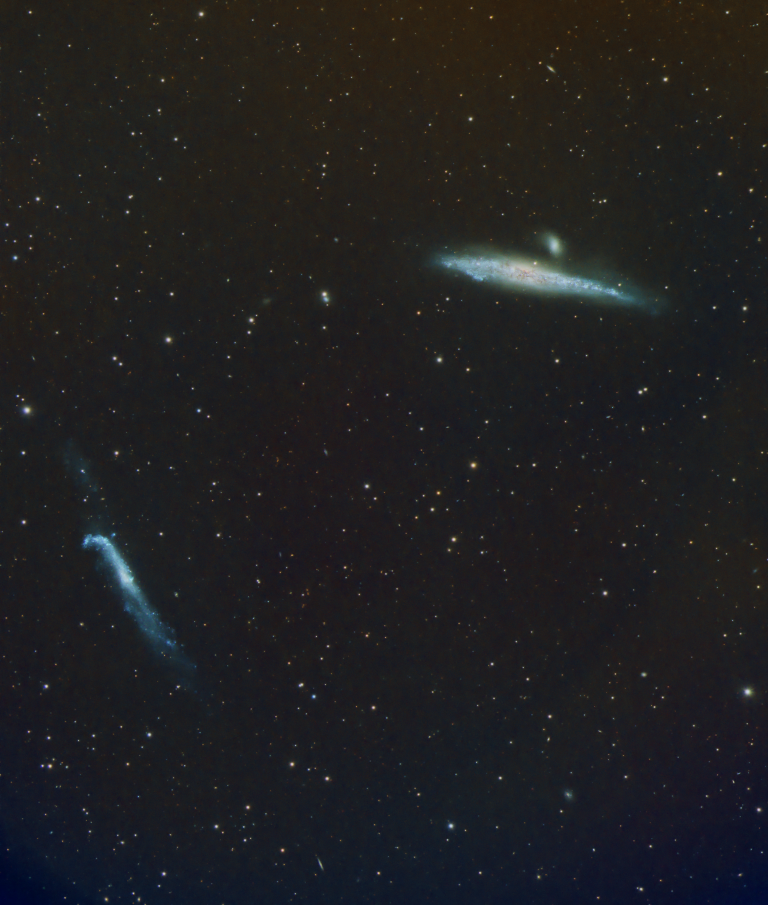
And here’s an earlier take, with more exaggerated colors and a little more artsy.
Similar Posts

  • The Pelican Nebula

    Granted this is only a portion of it, but for the life of me I don’t see a pelican in this thing. But, it’s still pretty. I processed this object two ways: using the “Hubble palette” that maps red, green, and blue to Sulfur, Hydrogen, and Oxygen emissions (that results in the pretty blue one)…

  • The Cave Nebula

    Formally SH2-155, the Cave Nebula lies about 2,400 light-years away within the constellation Cepheus. It’s part of a much larger region of gas and dust (called a molecular cloud). This region is mostly ionized Hydrogen, but there’s just enough Oxygen – blue in this image – to make for a pretty picture. Capturing that Oxygen…

  • Comet hunting!

    There’s a comet in the sky! They don’t appear this bright very often, so don’t miss what could be a once-in-a-lifetime chance to see a comet with your own eyes. It’s tough to spot here in suburbia with your eyes, but it’s easy to see with binoculars. Its official name is C/2020 F3 NEOWISE. Just…

  • Globular Cluster M13

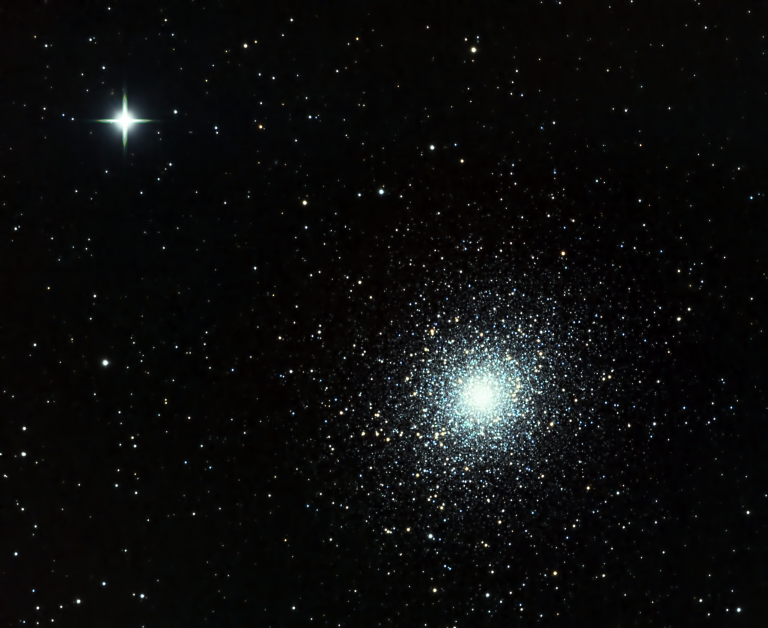
    M13, the great globular cluster in Hercules. You can see some of its interesting neighbors, including the galaxy NGC 6207 in the lower-left. While M13 itself is 25,000 light-years away just above our galactic plane, NGC 6207 is 37 million light-years distant. About halfway between the two, the galaxy IC 4617 is also visible –…

  • A Cosmic Sunflower

    Last night I revisited M63, the Sunflower Galaxy. More formally M63, the Sunflower Galaxy is about 25 million light-years away. It’s about the same size as our Milky Way, but is classified as a “flocculent spiral” galaxy due to its poorly defined spiral arms. The more distant edge-on spiral galaxy on the right doesn’t show…

Leave a Reply

Your email address will not be published. Required fields are marked *