Similar Posts
The sun is still cranky!
Busted out the solar telescope, now that fall has finally come to central Florida and the weather’s nice again! We’re still in the midst of a solar maximum, and today’s flares did not disappoint. We kept the ‘scope out all day, and observed a smaller flare seen across from the big ones turn into a…
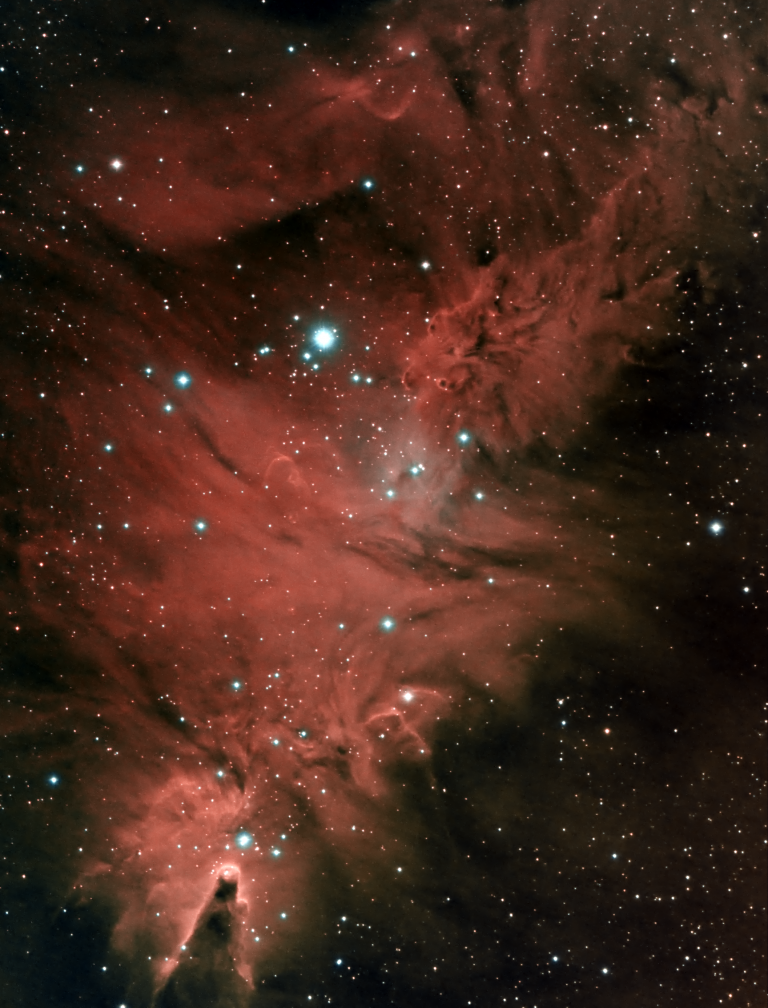
The Cone & Fox (revisited)
This is the Christmas Tree Cluster (turn the picture upside down and you might see it!) But the real focus here is the Cone Nebula at the bottom of the image, and the Fox Fur Nebula in the upper-right. Lots of red Hydrogen gas here being ionized by the young stars it formed. Also visible…
Another year, another Bode’s Galaxy image
Every year I try to take a better image of M81, Bode’s Galaxy. It’s located about 12 million light-years away, which is unfathomably far but close by galactic standards. Look closely, and you’ll see a faint splotchiness in the background. This is the Integrated Flux Nebula (IFN,) composed of gases that lie just outside of…
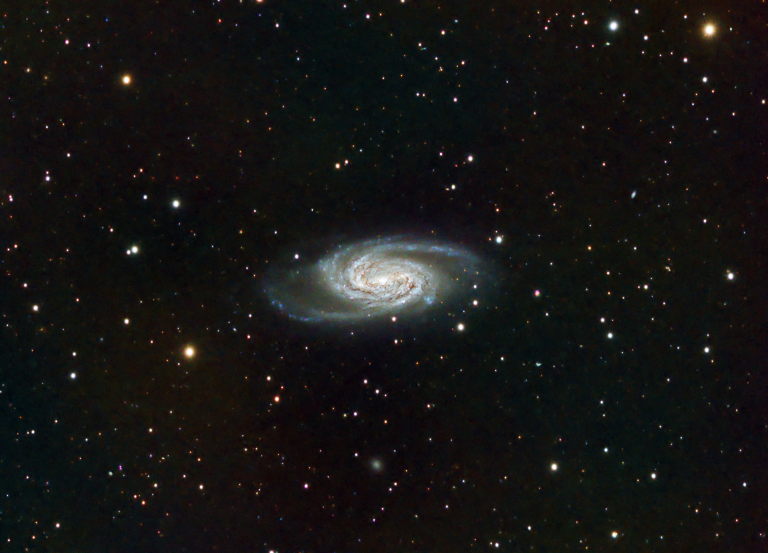
NGC2403: An obscure galaxy in an obscure constellation.
About 10 million light-years away within the constellation Camelopardalis lies NGC2403. It doesn’t get much love, but it was really an oversight in the famous Messier catalog that defines the most popular deep-sky objects. So let’s give it a little attention, and reflect on the fact that the light we’re seeing from this galaxy started…
A Star Cloud in Another Galaxy
NGC206 is an unusual object. It’s a cluster of stars, which in itself is not unusual at all… but it’s in ANOTHER GALAXY. The Andromeda Galaxy, to be precise. The fact that we can see it so clearly, two and a half million light-years away, boggles the mind. It’s that cluster of blue stars near…
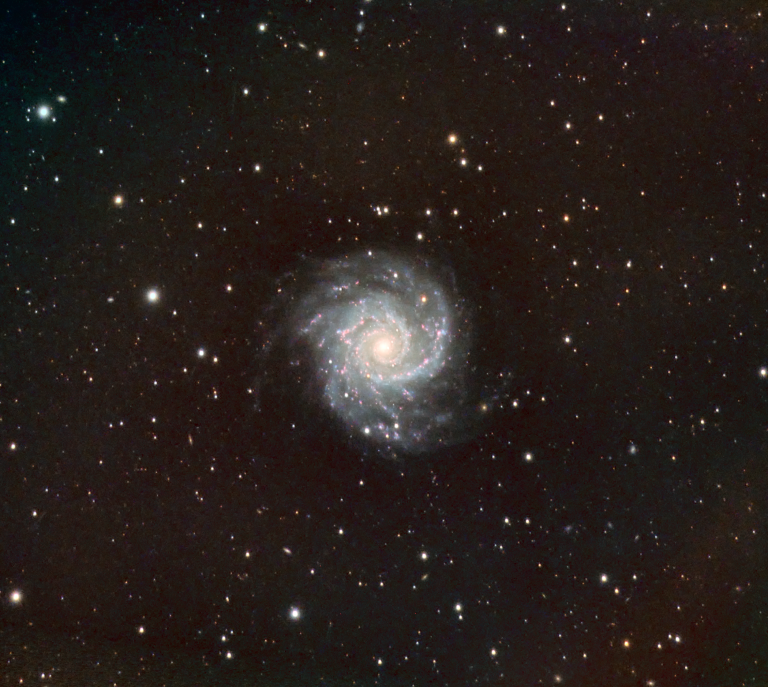
Revisiting the Northern Pinwheel Galaxy (M101)
Somehow I’ve neglected to go back to one of the showcase galaxies of the spring sky with newer equipment and software: M101, the “Pinwheel Galaxy.” Located about 21 million light-years away within Ursa Major, this relatively close galaxy shows lots of active star-forming regions revealed by red HII gas. Those red spots are nebulae in…