Similar Posts
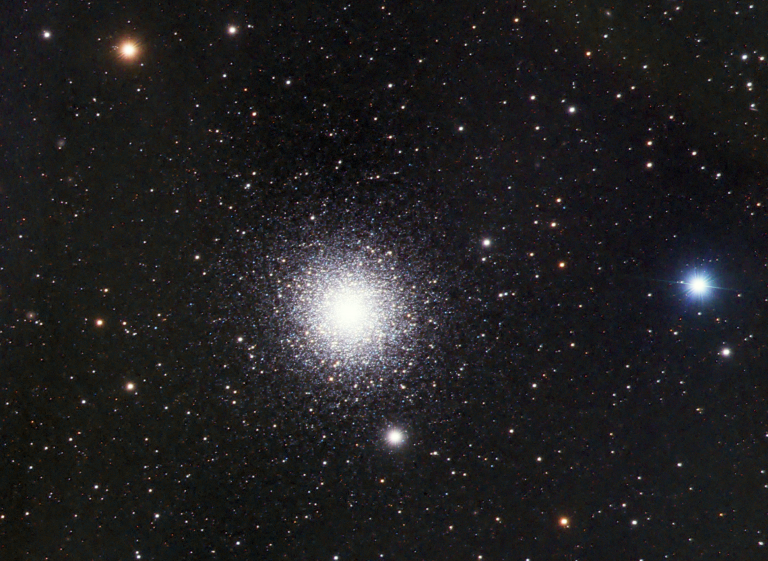
Revisiting globular cluster M3
Located about 34,000 light-years away within the constellation Canes Venatici, this tight ball of half a million stars formed just outside the disk of our galaxy – and so its stars never got mixed in with it. They’ve just been sitting there for over 11 billion years. One of the prettiest globular clusters in the…
A Tulip and a Supernova
In these short summer nights, I want to take advantage of every moment of darkness. Right now, the galaxy M100 is up in the hours before midnight, and the “Tulip Nebula” – formally SH2-101 – rises just as M100 sets. So for this past week, I’ve been imaging both objects. But no more clear skies…
The California Nebula
The “California Nebula” (NGC1499) does actually kinda look like California, if you look at the whole thing. But the whole thing is too big in the sky to fit within the field of view of my telescope. So, here’s an interesting portion of it near one of its ends at least. From this angle, it…
Beating light pollution with a new synthetic RGB algorithm
Imaging deep sky objects from a suburban driveway forces one to find ways to deal with light pollution. Light pollution is the enemy of astronomers – but in reality, there are ways around it. Some of the most beautiful objects in the cosmos are called emission nebula. They are clouds of gas, often where new…
The Spider Nebula
Here’s IC417, commonly known as the “Spider Nebula.” Just outside of the frame is a smaller one called the “Fly Nebula,” but my field of view isn’t quite big enough to capture them together! It’s about 10,000 light-years away, in the constellation Auriga. Imaged over 15 hours; narrowband nebula blended with RGB stars.
My best shot of Jupiter yet!
A lot of things have to come together for a good image of the planets. The air needs to be as still as possible, the planet you’re imaging needs to be as directly overhead as possible, and the planet itself should be as close to the Earth as possible. And then, all your equipment has…